The Acid Behind the Zero: Why THCA Belongs Beside Delta-9 THC on a UK CBD Certificate
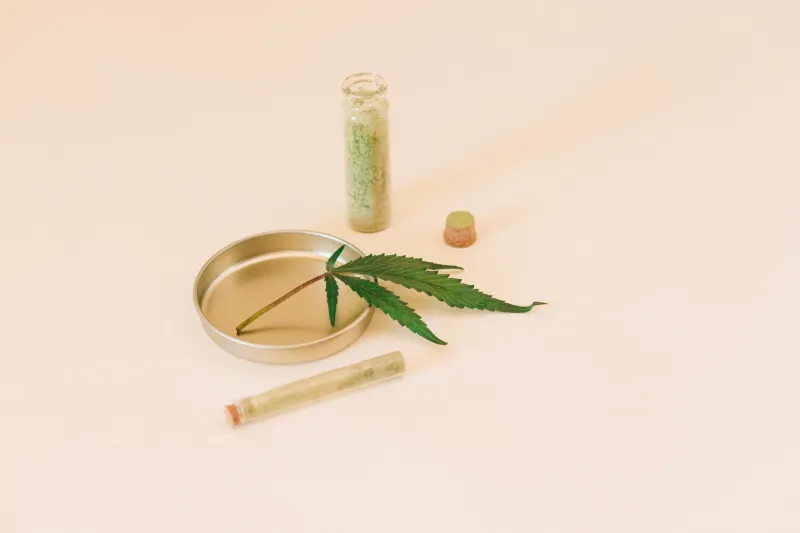
On a UK CBD certificate of analysis (COA), few lines attract more attention than delta-9 THC. A result of 0.0%, or a note that the cannabinoid was not detected, is often lifted into marketing copy and read as proof of purity. It is a useful data point. It is not, on its own, a complete account of tetrahydrocannabinol in the sample. At CBD Purist, the working rule is simple: a certificate is evidence to be read, not a badge to be displayed.
The acid line beside the neutral line
Delta-9 THC is the neutral, psychoactive form that most buyers have in mind. THCA is its acidic precursor. In fresh plant material, a substantial share of the THC family can be present as THCA rather than as delta-9 THC. Heat and time can decarboxylate THCA, removing the acid group and converting it towards delta-9 THC. That is why a certificate that reports only the neutral line can tell a narrower story than the reader assumes.
The two lines are not interchangeable. One describes what is already in the neutral form. The other describes a related acid that can, under the right conditions, become the neutral form. A buyer does not need to treat every product as though conversion is inevitable. But a buyer should be able to see whether the acid was measured at all.
What a zero can leave out
Imagine a report that lists delta-9 THC at 0.0% and THCA at 0.10%. The first line may be accurate, but the second changes the picture. Using the conventional mass conversion, total THC equivalent is roughly 0.0% + (0.10% × 0.877), or about 0.088%. If the delta-9 figure is 0.05%, the same THCA line gives roughly 0.138%. The arithmetic is simple. The judgement is not: a calculated total is an estimate built from two reported values, and it is only as reliable as their units, limits and method.
That example is illustrative, not a template for every certificate. Its purpose is to show why a single zero cannot answer a two-line question. If THCA is absent from the report, the reader does not know whether it was measured and found below a limit, measured and omitted, or not measured at all. Those are different situations, and they deserve different weight.
The conversion factor is not a lab result
The 0.877 factor adjusts for the difference in molecular mass between THCA and delta-9 THC. It is a standard shorthand, not a universal guarantee. Some laboratories report a total THC figure directly; others report THCA, THCA-A or a total acidic cannabinoid line. A buyer should not mix units, assume a percentage and a mg/g figure are interchangeable, or apply the factor to a number that is already expressed as THC equivalent. Where the report states its own total, that figure should take precedence. Where it does not, any calculation should be presented as an estimate, not as a finding.
This matters for UK buyers because a calculated number can acquire an air of precision it does not deserve. Two rounded values, multiplied and added, do not produce a highly precise result. They produce a better question. The question is whether the brand can show the underlying lines, the units and the reporting limits, rather than a single figure presented without context.
Limits turn zero into a range
A reported zero is rarely a statement that the laboratory looked for a molecule and found none anywhere in the universe. It usually means the result fell below a limit of detection or a limit of quantification, or that a very small value was rounded. If THCA is reported as less than 0.05%, the true value is not necessarily zero; it is somewhere below that boundary as defined by the method. The same logic applies to a delta-9 line shown as 0.0%. Without the limit, the reader cannot tell whether the result was 0.00%, 0.04% or simply below the reporting threshold. A single zero without a limit is a conclusion without its working.
This is not a reason to treat every certificate as deceptive. It is a reason to read the small print before repeating the large print. A brand that publishes a clear limit and a clear result has given the buyer something useful. A brand that publishes only a zero has given the buyer a headline.
Method and sample context
Chromatography choice matters. High-performance liquid chromatography (HPLC) can separate acidic and neutral cannabinoids, allowing THCA and delta-9 THC to be reported on their own lines. Gas chromatography (GC) uses heat, and depending on the method and preparation, acidic cannabinoids may decarboxylate in the instrument. A GC report may therefore present a delta-9 THC result that is closer to a total THC measure, or it may handle the conversion in a different way. The point is not that one method is inherently better. The point is that the method line changes what the number means, and a brand should be able to explain it.
Sample context matters too. A certificate for a raw extract is not automatically a certificate for the bottled oil a customer receives. The report should identify the sample, the batch, the date of testing and whether the material was prepared as sold. A total THC calculation performed on an extract may not describe the finished product after carrier oil, flavour or processing.
A reading order for UK buyers
- Find both lines. Look for delta-9 THC and THCA. If THCA is absent, look for a stated total THC figure. If neither appears, ask why.
- Check the units and basis. Confirm whether results are % w/w, mg/g or mg/ml, and whether they refer to the extract or the finished product.
- Read the limits. Locate the limit of detection and limit of quantification. Treat not detected and 0.0% as threshold statements, not absolute absences.
- Read the method. Identify HPLC or GC and whether acidic cannabinoids were measured separately or converted.
- Match the batch. Confirm that the certificate belongs to the product and batch in front of you.
Questions that produce evidence
If a UK brand publishes only a delta-9 THC zero, the useful response is not hostility but a request for the missing context. Does the COA report THCA separately? If not, why? Is total THC stated by the laboratory or calculated by the brand? What are the detection and quantification limits for each cannabinoid? Was the sample the finished oil? Does the batch reference on the certificate match the batch on the bottle? These questions are answerable. A brand with a well-documented batch should be able to answer them without treating the request as an accusation.
Why the whole number matters
Purity claims are often built on absence: no solvents, no pesticides, no heavy metals, no THC. Each absence needs a method and a limit behind it. THC is no different. A delta-9 result of 0.0% may be entirely accurate for the neutral cannabinoid. But if THCA is omitted, or if the brand repeats the zero without saying how it was measured, the buyer has been given a fragment. The more transparent presentation is not necessarily a scarier number. It is a number with its boundaries visible.
The question for a UK CBD buyer is not whether a 0.0% line is false. It may be perfectly true. The question is whether it is the whole number. A certificate that leaves THCA unmentioned, or a brand that treats a single zero as proof of purity, has not yet answered that question. Read the acid line beside the neutral line, check the method and the limits, and ask for the total.