Below the Line: What 'Not Detected' Really Means on a UK CBD Certificate

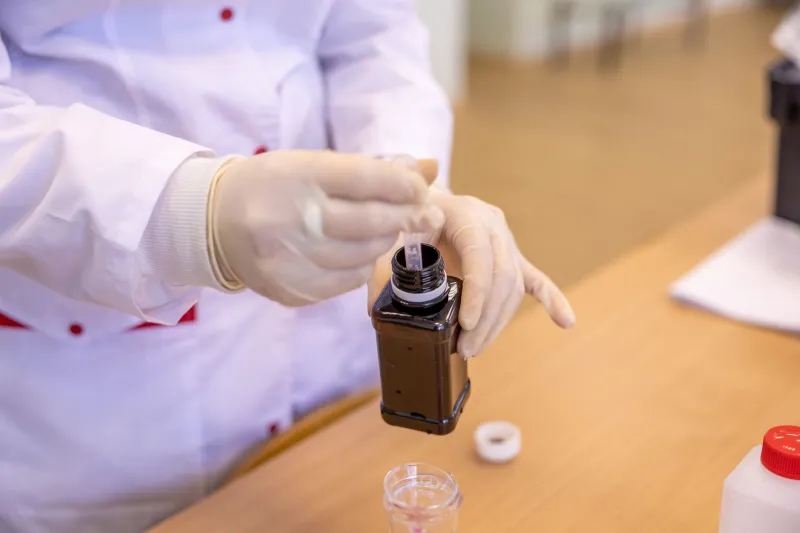
Photo: BiblioArchives / LibraryArchives from Canada, CC BY 2.0, via Wikimedia Commons
A certificate of analysis is often treated as a binary document: a contaminant is either present or it is not. In practice, the most important line on many UK CBD certificates is not the result at all. It is the threshold beneath which the laboratory could not see. Two certificates can both say 'not detected' for the same pesticide while ruling out very different concentrations. For a buyer trying to judge purity, that difference matters more than the tick in the results column.
A Clean Result Depends on a Sensitive Test
Laboratory analysis does not establish absolute absence. It establishes absence above a defined reporting threshold. That threshold is shaped by the method, the instrument, the sample preparation and the laboratory's own validation. A certificate that reports 'not detected' without disclosing the limit of detection is therefore making a narrower statement than it appears to make. It says that the method found nothing at the level it was capable of looking. It does not say that nothing is there.
This is not a technicality designed to undermine laboratory work. It is a routine feature of analytical chemistry, and reputable laboratories usually state their limits openly. The difficulty arises when a brand presents 'not detected' as though it were a universal clean bill of health, or when a certificate omits the numbers that would allow a reader to judge how much reassurance the result actually provides.
The Two Numbers Behind Every 'Not Detected'
The limit of detection, or LOD, is the lowest amount of a substance that the method can distinguish from background noise. At that level, the laboratory can say that something is probably present, but it cannot reliably quantify it. The limit of quantification, or LOQ, is the lowest amount that can be measured with acceptable accuracy and precision. Below the LOQ, a result may be reported as 'not detected', 'below LOQ' or 'trace', depending on the laboratory's conventions.
For a purity-focused buyer, the LOQ is often the more useful figure. It represents the boundary between a measured value and a vague signal. If a certificate states that lead was not detected with an LOQ of 0.01 mg/kg, that is a materially different claim from a certificate stating that lead was not detected with an LOQ of 0.1 mg/kg. The first rules out a concentration ten times smaller than the second. Without the LOQ, the reader cannot tell which situation applies.
Why Laboratories Report Different Thresholds
Differences in reporting limits are not automatically a sign of poor practice. Laboratories use different instruments, different extraction methods and different sample preparation routines. A method optimised for one matrix may be less sensitive in another. Hemp extract is a complex material, and the presence of cannabinoids, lipids and other compounds can affect how cleanly a target substance is isolated. A laboratory may also validate a method across a broad panel of pesticides, which can require compromise on individual limits.
What matters is whether the threshold is disclosed and whether it is appropriate to the claim being made. A certificate that reports a pesticide panel at a limit of 0.1 mg/kg may be perfectly valid for some purposes. It is weaker evidence for a brand that markets its oil as rigorously screened for trace contamination. The buyer's task is not to demand a single universal limit across every laboratory, but to notice when the limit is absent, inconsistent or quietly unimpressive.
Reading Pesticide, Solvent and Metals Panels Side by Side
Pesticide panels are often the clearest illustration. A certificate may list dozens of compounds, each with a result of 'not detected'. If the reporting limit for each compound is shown, the buyer can see whether the panel is genuinely sensitive or whether it is operating at a level that would miss small residues. A long list of compounds is not, by itself, evidence of thoroughness. A shorter list with credible limits and clear method details may be more informative.
Residual solvents require similar scrutiny. Solvents such as ethanol, hexane or acetone may be reported against a specification, but the specification is only meaningful if the method can measure below the relevant limit. A certificate that reports 'not detected' for a solvent at a limit above the level of interest is not demonstrating the same control as one that reports below it. The same logic applies to heavy metals. Lead, cadmium, arsenic and mercury are often reported in milligrams per kilogram, and a low LOQ is central to the value of a 'not detected' result.
The Dilution Trap and Other Ways Sensitivity Is Lost
A less obvious issue is sample preparation. If a sample is diluted before analysis, the reported limit in the original material must be adjusted accordingly. A method that reports a limit of 0.01 mg/kg in the prepared solution may correspond to a much higher limit in the product as sold. Certificates do not always make this adjustment easy to follow, and the dilution factor may sit in a method note rather than beside the result.
Brands and laboratories can also vary in how they treat results between the LOD and LOQ. One laboratory may report 'not detected' for anything below the LOQ, while another may report 'trace' or 'present below LOQ'. The first can look cleaner on a summary page. The second is often more transparent. A buyer should be wary of certificates that appear to have no grey zone at all, particularly when the underlying method is not described.
Questions That Expose a Weak Certificate
The most practical response is to ask direct questions. What was the limit of detection and the limit of quantification for each contaminant panel? Which method was used, and was it accredited? Was the sample diluted, and if so, what is the reporting limit in the original product? Does 'not detected' mean below the LOD or below the LOQ? These are not adversarial questions. They are the same questions a careful laboratory would expect from a serious buyer.
A brand that cannot answer them may still sell a legitimate product. But it has not given the buyer enough information to judge the purity claim. A brand that answers them clearly, and publishes the limits alongside the results, has done something more valuable than adding another 'passed' stamp to its packaging. It has made its evidence checkable.
What a Buyer Can Reasonably Conclude
'Not detected' is a useful result, but it is not a synonym for zero. It is a statement that a particular method, at a particular sensitivity, found nothing above a particular threshold. The threshold is part of the finding. When a UK CBD certificate shows that threshold, the buyer can compare it with others and decide whether the claim of purity is proportionate. When it does not, the honest conclusion is not that the product is contaminated. It is that the certificate has not yet told the whole story.